
Flying Wing
SUBJECT: Aeronautics
TOPIC: Gliding flight
DESCRIPTION: An acrobatic flying wing is constructed from plastic
foam trays obtainable from a supermarket.
CONTRIBUTED BY: Norm Poff (adapted from a design by Paul Mcilrath.)
EDITED BY: Roger Storm, NASA Lewis Research Center
MATERIALS:
Plastic foam meat or pastry tray, about 10 inches long, from a supermarket
Sharp cutting knife and cutting surface
Emery board, sandpaper, or metal file
Cellophane tape
Dime
Marker pen
Scissors
PROCEDURE:
1. Cut out and trace
the Flying Wing pattern on the bottom of the foam tray.
CLICK HERE TO GO TO THE TEMPLATE
Position the pattern so that the shaded wing tips lay on one of the upturned
edges of the tray. When cut out, the wing tips will have a permanent upward
bend.
 2. With the emery board, sandpaper,
or metal file, shape the upper surface of the Flying Wing into an airfoil.
Use the cross-section diagrams as a guide for shaping. Take your time and
try to keep both sides symmetrical. This part is better done outdoors.
2. With the emery board, sandpaper,
or metal file, shape the upper surface of the Flying Wing into an airfoil.
Use the cross-section diagrams as a guide for shaping. Take your time and
try to keep both sides symmetrical. This part is better done outdoors.
3. Tape the dime to the underside of the wing so that it is positioned
just forward of the center mark. It will probably be necessary to adjust the
position of the dime a few times to get the best position for flight. The
Flying Wing is ready for test flights.
BALANCING AND
FLYING THE FLYING WING:
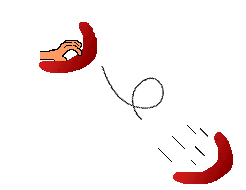 Go to an open area and hold the
Flying Wing in your hand as shown in the diagram. Toss the wing gently
straight forward. Observe the flight of the Flying Wing.
Go to an open area and hold the
Flying Wing in your hand as shown in the diagram. Toss the wing gently
straight forward. Observe the flight of the Flying Wing.
PROBLEMS AND CURES
| FLIGHT PATH | CORRECTION |
| FLIES STRAIGHT GLIDES SMOOTHLY | DON'T MESS WITH IT! |
| BANKS TO THE RIGHT | SLIGHTLY FLATTEN THE RIGHT WING
TIP BEND |
| BANKS TO THE LEFT | SLIGHTLY FLATTENT THE
LEFT WING TIP BEND |
| STALLS | MOVE DIME SLIGHTLY
FORWARD |
| DIVES TO THE FLOOR | MOVE DIME SLIGHTLY
BACKWARD |
DISCUSSION:
The shape of the Flying Wing is adapted from the zanonia seed which
is found in southeast Asia. When mature, the seed drops from the vine and
glides to a new location to reproduce itself.
To provide stability
in flight, the wing tips of the Flying Wing are upturned. These tips appear
to serve as drag rudders that keep the trailing edge of the wing trailing
in flight. The presence of the upturned wing tips also directs air flowing
over the wing tips upward. This results in a downward thrust that attempts
to pitch the trailing edge of the Flying Wing downward around its center
of gravity. The dime is taped to the underside of the leading edge of the
Flying Wing to increase its weight there and balance the pitching tendency
during gentle, gliding flight. At higher forward velocities, the downward
thrust of the wing tips is magnified, pitching the trailing edge down and
the leading edge up. The Flying Wing begins looping maneuvers and continues
until drag slows it and the Flying Wing gently glides to the ground.
 BACK TO AERONAUTIC
ACTIVITIES INDEX PAGE
BACK TO AERONAUTIC
ACTIVITIES INDEX PAGE
Aerospace Education Services Project
Oklahoma State University