| April 2003 | Vol. 1, No. 1 | ||
In This IssueProgram Updates
|
MRO! Goes NonprofitThe people and mission of Michigan Reach Out! began seven years ago under the sponsorship of the National Science Foundation Center for Ultrafast Optical Science at the University of Michigan. In the spring of 2002, we moved off campus and registered with the State of Michigan as a nonprofit organization. Since then, we have put a Board of Directors in place, achieved federal 501(c)(3) status, and begun a fund-raising campaign. We offer special thanks to the Herbert H. and Grace A. Dow Foundation, which provided the seed capital to get us started—and to our faithful volunteers and site leaders, who kept our programs going during the transition. Our vision is to link college and community mentors with community children and teens, and to promote math and science literacy, by
The best is yet to come! | ||
ContactsJeannine LaSovage, e-mail Debra Hamann, e-mail Martha Toth, e-mail | |||
Program Updates | |
2002–2003 Program SitesArrowwood Hills Community Center Bryant Community Center Hikone Recreation Center North Maple Community Impact Center Pattengill School Pinelake Village Community Center |
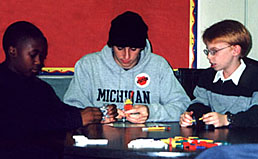
Science ClubsHands-On Science Clubs meet weekly. University of Michigan students and a few other volunteers bring experiments and activities, help with science fair projects, bring in demonstrators, and arrange for family field trips to museums. This year, 70 mentors have volunteered in our seven science clubs, serving more than 200 children. Although our programs have not been as rich during this transitional year, clubs have typically done such things as make their own polymers, build models of cells, experiment with liquid nitrogen, craft paper rockets and rocket cars, investigate acids and bases found around the house, dissect eyes and hearts, and investigate fingerprints. Visitors have brought ambulances and smoke houses, laser and strobe-light experiments, and fish-tank and bubble optics activities. Families have joined children and their mentors at the Ann Arbor Hands-On Museum and at the University of Michigan’s Exhibit Museum of Natural History. For the second year, mentors and other volunteers have coached many children—not just club members—in selecting, implementing, and writing up science fair projects. Academic MentoringScarlett Middle School This program moved to Scarlett Middle School, where we have been able to link the school with its immediate community. After a school secretary helped us to get flyers out, we reaped a harvest of retirees and other adult mentors from Colonial Square and other nearby neighborhoods to supplement our faithful university volunteers. |
This school year, 48 teens met at least weekly with their mentors at Scarlett after school. Many mentors went beyond the call, meeting more frequently with their teens, meeting with parents, attending school concerts, sitting in on science or math classes, and helping with science fair projects. The actual mentoring has focused on basic math skills, where our teen mentees have gaps in knowledge that impede their progress. By next fall, if our funding has stabilized, we hope to have an individualized, computer-based math program available to help, and we will expand to other middle schools. We extend deep thanks to the Scarlett MS staff for their warm welcome and cooperation. As we outgrew the room donated for our use, we were able to expand into the school's computer lab. We have plans to take greater advantage of that asset next year! |
||
Evaluation FeedbackEnd-of-semester surveys from the Scarlett program offered telling participant responses. Almost universally, mentors and mentees would improve the program by having more time to spend with one another. Most mentors found orientation and ongoing training (for those who attended our seminars) useful. The concept of Learning Styles was new to many, and gave them insight into why their mentees could not simply replicate their own school strategies. After some experience with their teens, mentors realized that they are perfectly capable of learning math and science—but not from lectures, and that many do not do well on traditional tests, even when they can demonstrate competency in other ways. Besides opening their eyes to the complexities of underachievement in schools, these realizations left mentors with a deep, if belated, appreciation for the support and guidance they had received from parents and teachers.
|
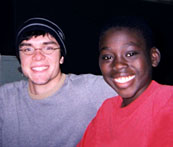
Mentor Voices“I think it really increases their confidence, both academically and socially, and I wish every kid could have that opportunity.” - Julia “It has been very positive. It has increased my personal feeling of importance and further motivated me to become a teacher.” - Adam “I really enjoy mentoring. It gives me an opportunity—which I love—to leave campus every week and do something completely different. I need this to stay sane at school. At the same time, I feel like I am being useful, and the connection I can make with my mentee is priceless.” - Gwen “The consistency of having the same kid is very important, and it makes you want to come back, because you start to get attached to your kid.” - Jake “The experience has widened my eyes as to how different middle school is from when I attended, and how just one hour a week can really make a dramatic impact.” - Kelly “I feel I need to be more responsible because I have a non-family member looking up to me.” - Becca “It was a great experience! It has made me consider teaching as a profession.”- Abhaya |
Meet Our Mentors!We gratefully recognize this year’s math and science mentors and our past career mentors | |||
|---|---|---|---|
Baxter Allen |
Greg Earhart |
Felipe
Karian-Torres |
Kyle Pine |
| Please let us know if we missed your name! | |||
Making a Difference — One Child at a Time | |||
Participant Voices“Mom and I wanted me to have a Big Brother. That didn’t happen, but I got a mentor here. My mentor likes to play chess with me and sometimes we play catch, too. He helps me do my homework and he helps me learn things I didn’t learn in school that I should have learned. Sometimes I don’t know that I don’t know something. But he helps me figure that out. I really am glad I have Reach Out!, and I come after school just about whenever I can.” - Scarlett MS teen “Reach Out! does a good job of pulling together different people and groups for our students. Working together, we were able to have a Kiwanis Builders Club to support our students planning and doing many community outreach projects by themselves and also with Kiwanis, to offer career mentoring, to provide job shadowing opportunities with business people in Ann Arbor, Saline and Chelsea, and to link UM students with children who wanted academic mentoring. I couldn’t do all these things by myself but, by working with Reach Out!, we brought many people into their lives, connected with resources (many that I didn’t know about), and certainly gave our experiences and opportunities they otherwise wouldn’t have had.” - Slauson Middle School teacher “Greetings to the Reach Out! team. I have noticed a wonderful and positive difference in the quality and understanding of the homework assignments of the students in my class who have received your assistance. Being prepared for class has given them self-confidence and made participation easier for them. Thank you so much for your support.” - Scarlett Middle School teacher |
Lunch-Time Science at Pattengill School | ||
|
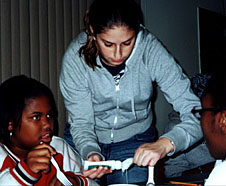
Where can you study science? The answer is simple—everywhere! Students in our Pattengill Science Club were captivated by the realization that science’s reach is so extensive. Composed of mostly young students, this group came with a desire to understand the way science relates to their own bodies. Slowly, together, we discovered some of the ways science and biology can explain some of the body’s mysteries. Another week, some students played the role of a water contaminant, using substances such as salt and vinegar, while others became workers assigned to examine the cleanliness of drinking water. Expecting pollutant identification to be a piece of cake, the students were surprised and even frightened at the possibility that their drinking water could be contaminated without their awareness. This realization quickly spurred many conversations about preventing pollution, and we all left with a heightened awareness of our relationship with the environment. One of the most important observations I could
possibly make about science club is that we have fun. The students
enjoy learning and the time they spend with their friendly and talented
mentors. Every day, they come eager to learn and experiment with the
hope of gaining some insight into their own lives. My hope and belief
is that this excitement will only grow, as the club itself becomes
more of a staple in their precious lives. |
The Pattengill Science Clubs have been incredibly successful, with enough “customers” to prompt a waiting list for the next series. We have done hands-on science involving states of matter, the scientific method, weather, and astronomy. The kids have had the opportunity to work with “ooze” and with K-nex building toys, to make their own tornado in a jar, and to create their own moon craters. Although, by far, the students have shown the most interest in astronomy, they have been able and willing to learn about all different kinds of science. Many students took home the “ooze” experiment and shared it with their friends and family, mixing cornstarch and water in a bowl and showing the different states of matter that are formed depending on how the mixture is handled. These kinds of experiments are incredibly useful in order to get parents and other peers involved in what science club is doing and what it is teaching the kids. Yet, although exposing the students (and their families) to as many different types of science as possible is a main goal of Reach Out!, the children seem to benefit most by the close bond they form with their mentors. After only a short time, each of the mentors has formed relationships with his or her own small group of children. The students look up to their mentors not only as someone to teach them or someone to eat lunch with, but also as someone concerned about them. With a familiar face that they look up to and trust, they feel completely comfortable taking on new challenges in science that they may once have found intimidating. The mentors come every week knowing that these specific kids are going to be looking for them. They also take time out after the kids leave to fill out evaluations dealing with concerns they have about their specific students, and reflecting upon what their kids are learning and how they can make this experience an even better one. Our volunteers serve an even larger group by
offering science fair mentoring and advice. One teacher noted that
one student “would not have been able to participate in the
science fair without your help.” It is all part of offering
resources and support to children who would otherwise not have them.
| |
Networking & Fund-raisingOur vision is to become a county-wide—and eventually statewide—mentoring center. We will share best practices, orientations and training sessions, evaluation strategies, and efforts to recruit volunteers and to raise funds. MeetingsIn the past few months, we have met with these folks to talk about uniting some of our programs and efforts:
Similar networking and follow-ups to these meetings are planned. |
Web CornerOur Web site moved from a university server to this URL in 2002. After the relocation, it took time for our users to find us again. Although total usage is about 50% of the former level, it continues to grow, from an annualized level of 220,000 page requests in June to one of nearly 3 million by March 2003. More than 4,000 different pages within the site are requested per month. Visitors have come from every one of the United States and its territories, plus more than 113 other countries, from “.ae” (United Arab Emirates) to “.za” (South Africa). | |
Fund-raisingOur proposals last spring to the U.S. Department of Education and the National Science Foundation, both in partnership with Ann Arbor Public Schools, were not funded. We thank Senator Carl Levin for his support in these efforts! We are now awaiting feedback on a preliminary Informal Science Education proposal to NSF and working on the full proposal. A proposal submitted to the Ann Arbor Area Foundation and Pfizer for funding to secure our elementary science club programs and coordinator was successful. We are pleased and grateful to announce that this proposal was granted. Several informal proposals were made to small family foundations; some responded with donations and others are still in process. These and other donors, including a gratifying number of individual supporters, are listed on the back cover of this newsletter. Our sincere thanks to all! | ||
Who Stands Behind Us: | ||
Our Contributors
Herbert H. & Grace A. Dow Foundation
John Barfield “Thank You” to Our Generous Donors!Michigan Reach Out! |
Our Board of DirectorsPresident: Barry Borgerson, founder and president of Complete Leadership, Inc., which provides individually tailored transformational coaching for executives to enable the achievement of peak performance. Dr. Borgerson is a past and current fundraiser for MRO! and sponsors our Web site. Vice President: Ben Kaufman, manufacturing engineer, General Motors; University of Michigan graduate; past site leader; UM Reach Out! alumnus Secretary: Bridget Briley, University of Michigan student; past and current site leader Treasurer: Doris Calvert, Calverts’ Roll-Off Containers, Inc.; past volunteer, site leader, and coordinator of several programs Director: Dave Coleman, University of Michigan student; past and current site leader [no longer active since May 2003 graduation; replaced by Sam Lulla, University of Michigan student; past and current site leader] Director: Tom Flynn, manager, Chelsea Proving Grounds Wind Tunnel, DaimlerChrysler Motors; past and current career resource provider; past program sponsor Director: Bob Galardi, Ann Arbor Public Schools; principal at two program school sites [no longer active since 2003 promotion] Director: Bill Schultz, professor of mechanical engineering at University of Michigan; leader at past and current sites; faculty advisor to UM Reach Out! Student Auxiliary: UM Reach Out! | |
| Our work is supported in part by | ||