
Page 2: Canoeing at Gallup Park
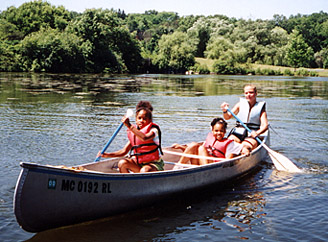
| Most of us had never been in a canoe before. |
|
|---|
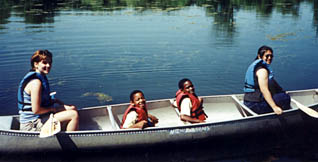 |
Some wanted to paddle and some just to ride. |
|---|
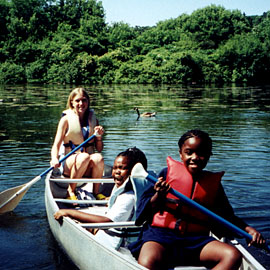
Some were not too sure about the whole idea! |
| |
|---|---|---|
If children are to learn to think like scientists, they need plenty of real, physical experiences, along with guidance in observing, predicting, and asking questions about how the world works. Camp served as an informal laboratory for this process. For example, while canoeing, participants had to theorize about why they were going in circles, about exactly what their oars were doing to propel them, about how they could change their technique to improve their control. We could theorize about the reasons for it but, whatever the explanation, many children today need to be prompted to ask "Why?" and to actively think about how and why things happen. Whether they become scientists or not, this habit of mind will surely affect their lives for the better, if only because an understanding of cause and effect opens the mind's door to the whole notion of personal power and responsibility. If things happen for predictable reasons and they can alter the terms of an experiment, that means they can also take active steps to control their own lives—rather than living as powerless victims. | ||
| Go to | ||
|---|---|---|
| Page 1 - Musical Adventures | Page 6 - Vehicles | |
| Page 3 - Domino's Farm | Page 7 - Picnicking | |
| Page 4 - Crafts & Projects | Page 8 - Waves | |
| Page 5 - Swing Dancing | Page 9 - Last Page | |